
• Home
  • About
  • First Step Counseling

Lord, have mercy…

~ My life. My story.

Lord, have mercy…

Tag Archives: sin

The Gift of Good-bye

24 Sunday Apr 2022

Posted by Janean Tinsley in My Story. My Faith., The Church

≈ Leave a comment

Tags

Culture, Gift of Good-bye, Jesus Christ, sin

skinny teen walking on sunset road
Photo by Julia Khalimova on Pexels.com

God’s various gifts are handed out everywhere; but they all originate in God’s Spirit. God’s various ministries are carried out everywhere; but they all originate in God’s Spirit. God’s various expressions of power are in action everywhere; but God himself is behind it all. Each person is given something to do that shows who God is: Everyone gets in on it, everyone benefits. All kinds of things are handed out by the Spirit, and to all kinds of people! The variety is wonderful:

wise counsel

clear understanding

simple trust

healing the sick

miraculous acts

proclamation

distinguishing between spirits

tongues

interpretation of tongues.

All these gifts have a common origin, but are handed out one by one by the one Spirit of God. He decides who gets what, and when. — 1 Corinthians 12: 4-11

This morning, as I was sitting in church, the pastor said something that has resonated with me all afternoon. He was talking about the importance of truth in the midst of today’s culture. It seems as though even self-proclaimed Christians are denying Jesus, ignoring the inerrancy of the Bible, conforming to sin, and living spiritually reckless lives. He mentioned that many Christians know about the nine gifts we are given according to scripture but we are likely unfamiliar with the tenth gift; that is the gift of goodbye. Now he was saying that with a bit of humor because that isn’t listed in 1 Corinthians 12. But as I’ve thought about it, I do believe it is a gift God gives us.

Jesus and the man

The Gospel of Mark tells us the story of a man who encounters Jesus. This man ran up to Jesus and fell on his knees before him. “Good teacher,” he asked, “what must I do to inherit eternal life?”

This man clearly knows the importance of God’s kingdom and he understands that it is Jesus who holds the answer.

The man is focused on the right thing but he mistakenly thinks he has all the power to make it happen. Jesus obviously sees this discrepancy in the man’s question versus his heart.

“Why do you call me good?” Jesus answered. “No one is good—except God alone. You know the commandments: ‘You shall not murder, you shall not commit adultery, you shall not steal, you shall not give false testimony, you shall not defraud, honor your father and mother.’”

The man is eagerly agrees with Jesus: “Teacher . . . all these I have kept since I was a boy.”

He has worked hard; he has kept the rules; he has tried his best. It all looks good on paper. He is probably thinking he has this wrapped up and well on his way to the heavenly promised land.

Then an amazing thing happened. It’s easy to overlook it. Scripture says, “Jesus looked at him and loved him.”

Read that again.

This is the only man in the entire Gospel of Mark whom we are explicitly told Jesus loved. And that’s startling given what the love of Jesus looks like in this story.

 Jesus loves this man too much to allow him to continue in his self-deluded little world that says his hard work is the way to God. Jesus refuses to invite this man into further ego-driven beliefs that just because he has checked off all the necessary boxes, he is on the narrow path to God’s kingdom. Instead, Jesus issues a command.

In scripture, Jesus often spoke in parables. It wasn’t always easy to understand the basic point but not in this case. Jesus was direct and incredibly clear. And with this one command, Jesus undermines the whole foundation on which the man has built his life.

“One thing you lack,” [Jesus] said. “Go, sell everything you have and give to the poor, and you will have treasure in heaven. Then come, follow me.”

No negotiation, no misunderstanding. He must sell everything.

At this the man’s face fell. He went away sad, because he had great wealth.

And there it is. The crux of the man’s story. He had great wealth. Why is that important? Because Jesus demands it all. That is the command. Period. It’s not just a hard command. It’s impossible, and it was supposed to be.

It’s an important moment because Jesus loves the man—and he lets him walk away. Jesus doesn’t chase after the man or change the rules. He simply says good-bye.

Jesus demands it all.

True then. True now.

Why would Jesus make the price so high? Why would Jesus demand something that can’t be done? Not because he’s cruel and harsh, but precisely because Jesus is love.

You see, the man had reduced God’s commands to something he could achieve. It was like a daily checklist that needed to be accomplished. He couldn’t see that this wasn’t about works but rather it was about the heart. If the man had simply surrendered to Jesus in that moment, he could have honestly said to Jesus, “I can’t do it alone.” But his identity was wrapped up in things of the world therefore there was no place for Jesus in his life. Not truly.

So, how does this relate to today and even the “gift of good-bye?”

Think back to what Jesus said to the rich young man. “Go, sell everything you have and give to the poor.” It’s easy to react to that: Of course he doesn’t mean I should do that. That would be ridiculous and impractical. He was only talking to that man. He just means I should be more generous. Yes, I think I can manage to be a bit more generous. I don’t have to actually suffer.

And that’s precisely the problem. We find a solution to the problem of obeying the commands of God—but we aren’t obeying Him at all. We decide what scriptures to live by and what scriptures to ignore. We decide that things, places, events, people are much more important than our relationship with God. We affirm sin and water down hard words of God to avoid upsetting people. We cling to traditions instead of God’s Laws. Our lack of obedience to God is exactly why Jesus said to the man, “Go, sell everything you have.”

Every command found within the pages of Scripture will expose your worldly anchors if you stop and listen. It is uncomfortable. It is hard. But it is there, in that authentic place, that you will truly learn to whisper those two little words: I can’t.

I can’t continue making the choices I’m making. I can’t continue hanging with the wrong people. I can’t continue to water down my beliefs. I can’t.

Two and a half years ago, I said, “I can’t.” I could no longer be part of a denomination that denies the divinity of Jesus Christ. I could no longer keep quiet about the way God was being pushed out of that worldly institution. I could no longer serve alongside those who mock God by claiming He makes mistakes. I fell to my knees and said, “I can’t.” And in that moment, the Holy Spirit gave me the gift of good-bye.

“And if no one will … even listen to what you have to say, leave that place, and once outside it shake off the dust of that place from your feet. Believe me, Sodom and Gomorrah will fare better in the day of judgment than that place.” — Matthew 10:14

Shaking off the dust of some place or someone you love is not easy. But without the gift of goodbye, given by the Holy Spirit, it is not possible. I’ve watched as several people I know and love have embarked on these good-byes within their own lives. It’s heartbreaking but also freeing. The more you push away from the world and all that it stands for, the closer Jesus Christ is to your every breath. Jesus showed us how to love, even to the point of good-bye. And sometimes it is through our good-bye that we show the most love of all.

What about you? Are you like the man, clinging to the riches of your world? Do you find the comfort of disobedience easier than the discomfort of giving it all away? Perhaps it is time for you to say, “I can’t” so you too can receive the gift of good-bye.


Share this:

  • Click to share on X (Opens in new window) X
  • Click to share on WhatsApp (Opens in new window) WhatsApp
  • More
  • Click to share on Facebook (Opens in new window) Facebook
  • Click to print (Opens in new window) Print
  • Click to email a link to a friend (Opens in new window) Email
  • Click to share on LinkedIn (Opens in new window) LinkedIn
  • Click to share on Reddit (Opens in new window) Reddit
  • Click to share on Pinterest (Opens in new window) Pinterest
  • Click to share on X (Opens in new window) X
Like Loading...

Paul DID speak about hell

02 Sunday May 2021

Posted by Janean Tinsley in The Church

≈ Leave a comment

Tags

hell, Jesus Christ, Paul, sin

I was sent a message today with the question, “Did Paul really not ever preach on hell?” Apparently, my friend’s preacher told the church that Paul didn’t talk about hell when sharing the Gospel. Instead, the preacher insinuated that if Paul didn’t preach about it, hell either doesn’t exist or isn’t important. *sigh*

“Yes, my dear friend, Paul warned of hell because he taught exactly what Jesus Christ taught.”

First things first … Paul never says the word “hell.” This is true. The word was not found in the Greek language. But to simply say he did not tell his listeners about hell is distorting the truth because Paul absolutely spoke of eternal consequences.

Paul spoke of the fate of ponērós. It is the Greek word for wicked. He taught that ponērós are condemned and will suffer God’s wrath. 2 Thessalonians 2:12 says, “All will be condemned who have not believed the truth but have delighted in wickedness.” Truth in Paul’s teachings is believing in Jesus Christ. Therefore, anyone who does not believe in the truth equates to wickedness.

Romans 2:5, 8 says, “But because of your stubbornness and your unrepentant heart, you are storing up wrath against yourself for the day of God’s wrath, when his righteous judgment will be revealed…But for those who are self-seeking and who reject the truth and follow evil, there will be wrath and anger.” Paul describes God’s action against unbelievers and deniers of the truth with the word “wrath.” Wrath is never used when talking about salvation and sanctification. Why? Because the believer is not wicked, requiring eternal judgment.

Paul is clear that those who are unrepentant of their sins and reject the Lord will face God’s wrath on the Day of Judgment. “It is because of these things (lust, idolatry, greed, sexual immorality, and other sinful deeds) that the wrath of God is coming on those who are disobedient.” Colossians 3:6

However, Paul doesn’t just give us the fate of the ponērós. He tells us the good news that those who believe in Jesus Christ will have eternal salvation, showing his listeners that there is a choice to be made: eternal salvation or eternal judgment.

• “Therefore, since we have now been justified [declared free of the guilt of sin] by His blood, [how much more certain is it that] we will be saved from the wrath of God through Him.” — Romans 5:9

• “For they themselves report about us, tellingwhat kind of reception we had among you, and how you turned to God from idols to serve the living and true God, and to [look forward and confidently] wait for [the coming of] His Son from heaven, whom He raised from the dead—Jesus, who [personally] rescues us from the coming wrath [and draws us to Himself, granting us all the privileges and rewards of a new life with Him].” — 1 Thessalonians 1:9-10

• “For God has not destined us for wrath, but for obtaining salvation through our Lord Jesus Christ, who died [willingly] for us, so that whether we are awake (alive) or asleep (dead) [at Christ’s appearing], we will live together with Him [sharing eternal life].” — 1 Thessalonians 5:9-10

Paul wrote the letter to the Galatian church to combat false teaching. He opposed the false teaching so strongly that he said, “But even if we or an angel from heaven should preach a gospel other than the one we preached to you, let him be eternally condemned! As we have already said, so now I say again: If anybody is preaching to you a gospel other than what you accepted, let him be eternally condemned!” — Galatians 1:8-9 Eternally condemned certainly does not equate to anything good.

Paul wants everyone to fully understand that they have a choice to make. And they must make it quickly. “He will give eternal life to those who keep on doing good, seeking after the glory and honor and immortality that God offers. But he will pour out his anger and wrath on those who live for themselves, who refuse to obey the truth and instead live lives of wickedness.” — Romans 2:7-8

Paul continues his teaching of hell. Romans 2:9, “There will be trouble and distress for every human being who does evil.” This is a picture of the afterlife because we know that those who do evil don’t always experience trouble and distress. It is most often the righteous who are persecuted and go through tribulation (trouble). Paul is teaching that those who reject God and do evil will experience trouble and distress in the next life rather than this one. It’s satan’s way of seducing us into turning our backs on Jesus Christ.

Paul was profoundly intent on sharing the Gospel everywhere he went. He did not leave out the parts that made people uncomfortable or offended them. He understood that their eternal souls were at stake with each word he spoke. Unfortunately, there are many preachers today who fail to live by this same conviction. They twist the words of scripture so that it’s more appealing to sinful ears. And the result is more sin, more wickedness, and more lost.

But Paul wasn’t finished. 2 Thessalonians 1:8-10 is one of the most important passages about hell that Paul preaches. “He will punish those who do not know God and do not obey the gospel of our Lord Jesus. They will be punished with everlasting destruction and shut out from the presence of the Lord and from the majesty of his power on the day he comes to be glorified in his holy people and to be marveled at among those who have believed.”

Everlasting destruction. This means that the punishment for those unbelievers and twisters of truth is to be “shut out from the presence of the Lord” eternally. If this isn’t hell, what is?

Paul talks of eternal destruction several times.

• The one who sows to please his sinful nature, from that nature will reap destruction; the one who sows to please the Spirit, from the Spirit will reap eternal life. — Galatians 6:8

• And in no way be alarmed or intimidated [in anything] by your opponents, for such [constancy and fearlessness on your part] is a [clear] sign [a proof and a seal] for them of [their impending] destruction, but [a clear sign] for you of deliverance and salvation, and that too, from God —Philippians 1:28

• For there are many, of whom I have often told you, and now tell you even with tears, who live as enemies of the cross of Christ [rejecting and opposing His way of salvation], whose fate is destruction, whose god is theirbelly [their worldly appetite, their sensuality, their vanity], and whose glory is in their shame—who focus their mind on earthly and temporal things. — Philippians 3:19

• “They perish because they refused to love the truth and so be saved.” — 2 Thessalonians 2:10

Quite simply, the ungodly will be destroyed, but believers will be given eternal life. Therefore, ‘eternal destruction’ is the severity of the punishment awaiting the enemies of God for eternity. Considering that Jesus spoke of heaven as a place of joy, the place where those not of God’s kingdom would be hell. Although Paul does not use the Greek words translated “hell,” he speaks about extensively.

Finally, Paul was an extraordinary apostle and his example is one to follow. But Paul was a sinful human being. Our ultimate teacher is Jesus Christ. Paul did not contradict Jesus so we can look to Jesus’s teachings for a final authority.

Jesus talked about hell more than any other person in scripture. In Luke 16, he describes a great chasm over which “none may cross from there to us.” In Matthew 25, Jesus tells of a time when people will be separated into two groups, one entering into his presence, the other banished to “eternal fire.”

Jesus says hell is a place of eternal torment (Luke 16:23), of unquenchable fire (Mark 9:43), where the worm does not die (Mark 9:48), where people will gnash their teeth in anguish and regret (Matt. 13:42), and from which there is no return, even to warn loved ones (Luke 16:19–31). He calls hell a place of “outer darkness” (Matt. 25:30), comparing it to “Gehenna” (Matt. 10:28), which was a trash dump outside the walls of Jerusalem where rubbish was burned and maggots abounded. Jesus talks about hell more than he talks about heaven, and describes it more vividly.

The fact is, without hell, there is no eternal punishment. Without eternal punishment, there is no need for salvation. Without salvation, there is no need for Jesus Christ. Be warned, my friends, of the false teachers. They tickle your ears with the teachings of satan, luring you closer to eternal destruction.

Share this:

  • Click to share on X (Opens in new window) X
  • Click to share on WhatsApp (Opens in new window) WhatsApp
  • More
  • Click to share on Facebook (Opens in new window) Facebook
  • Click to print (Opens in new window) Print
  • Click to email a link to a friend (Opens in new window) Email
  • Click to share on LinkedIn (Opens in new window) LinkedIn
  • Click to share on Reddit (Opens in new window) Reddit
  • Click to share on Pinterest (Opens in new window) Pinterest
  • Click to share on X (Opens in new window) X
Like Loading...

Good vs. Evil – the fight for the Church

26 Monday Apr 2021

Posted by Janean Tinsley in The Church

≈ 8 Comments

Tags

Church, God, Jesus Christ, Methodist, Mt Bethel, sin

“On April 26, Dr. Ray surrendered his credentials as an ordained elder in the United Methodist Church. Our pastor’s actions were done with a heavy heart, but also with a clear conscience.”

Most of you have likely not heard of Mt Bethel UMC in Marietta, Georgia even though it’s the largest Methodist church in north Georgia. This church has been a beacon in that area for over 175 years. They believe quite simply, “At the center of our mission is a great desire to evolve and stay relevant in our community–to find new ways to share an unchanging Gospel in a changing world.”

Sounds good, right? Well… this church has been in the religion news outlets the past few weeks. Why? Because the pastor of this very large, growing church believes in the truth of the Holy Bible. Rev. Dr. Jody Ray has been the senior pastor of Mt. Bethel for five years and has made it quite clear of his unwavering orthodoxy belief. The North Georgia Conference… well … it’s led by a very progressive bishop. Without so much as a consultation, the pastor received word he was being reappointed effective in less than a month. He and the church were caught off guard and requested the bishop reconsider. The answer was a strong, “no.”

“As an elder in the church I certainly understand the appointive process,” said Ray. “Unfortunately, my options were to accept the move, take a leave of absence, or surrender my credentials. That’s not exactly the way colleagues in the Order of Elders expect to be treated.”

So Rev. Ray announced today he was surrendering his credentials rather than stay embedded in the nightmare that the United Methodist Church has become because of the battle between good and evil.

For those not familiar with the ordination process in the UMC, it’s a long, exhausting process reaped in unobtainable expectations. In other words, it’s not for the faint of heart. It’s easily 10 years from start to finish, and more intensive then many residencies. Beyond the incredible hard work, time, and tears, the road to ordination is deeply personal because God calls us to the ministry and God ordains us. Unfortunately, many people have forgotten that very powerful fact. God is the ONLY one who can ordain us.

So why am I talking about all of this? Because I’ve been in a similar situation as Rev. Ray. Being placed in that position — new appointment, leave of absence, or surrender credentials — it’s incredibly painful. When you surrender your credentials, your life does not simply gone on. Your life is changed. You are changed. You ache deeply. You question yourself. You even question God. It’s not a simple choice. But it’s a necessary step when you can no longer represent a denomination because of their departure from God. And just like Ray, it all came down to being pro-sin or pro-Truth.

There are more and more of us who are being pushed out of the UMC simply for our unshakable faith in the inerrancy of scripture. It’s hard to even process that a church is no longer a place to hear Truth. It’s no longer a place to learn accountability to what’s right and wrong. It’s a place where the world has been embraced while God has been replaced. But so many churches from many different denominations are taking this approach. I focus on the UMC because of my personal experience.

There are several private forums online for those of us who are traditional believers. These forums provide a place for us to listen, lift each other up, discuss scripture, and pray together. Unfortunately, we are forced to be in hiding for our beliefs. Recently, we were warned to be very careful because we were being targeted. One person wrote, “Some one invited a friend of mine who could lose his/her job if affiliation here [the forum] was known. I recommended NOT participating here. Some clergy and lay conference staff are very vulnerable.”

It’s difficult for most people to understand the gravity of the pain clergy and laity are in because of the progressive leadership of the UMC. Threats, verbal assaults, loss of jobs, loss of friends… and this is only the beginning. With the split of the UMC looming , many more innocents will become victims of this fight.

For the time will come when they will not tolerate sound doctrine, but according to their own desires, will multiply teachers for themselves because they have an itch to hear something new. They will turn away from hearing the truth and will turn aside to myths. — 2 Timothy 4:3-5

Scripture tells us over and over to be aware of false teachers. God knew that this day would come. And He clearly knew we would fall prey without constantly abiding in Him.

Friend, if you find yourself in the midst of this battle, the time has come for you to rise up. Remaining lukewarm is no longer an option. Eternity is on the line. So I leave you with these words from the Apostle Simon Peter:

But there were also lying prophets among the people then, just as there will be lying religious teachers among you. They’ll smuggle in destructive divisions, pitting you against each other—biting the hand of the One who gave them a chance to have their lives back! They’ve put themselves on a fast downhill slide to destruction, but not before they recruit a crowd of mixed-up followers who can’t tell right from wrong.

They give the way of truth a bad name. They’re only out for themselves. They’ll say anything, anything, that sounds good to exploit you. They won’t, of course, get by with it. They’ll come to a bad end, for God has never just stood by and let that kind of thing go on.

God didn’t let the rebel angels off the hook, but jailed them in hell till Judgment Day. Neither did he let the ancient ungodly world off. He wiped it out with a flood, rescuing only eight people—Noah, the sole voice of righteousness, was one of them.

God decreed destruction for the cities of Sodom and Gomorrah. A mound of ashes was all that was left—grim warning to anyone bent on an ungodly life. But that good man Lot, driven nearly out of his mind by the sexual filth and perversity, was rescued. Surrounded by moral rot day after day after day, that righteous man was in constant torment.

So God knows how to rescue the godly from evil trials. And he knows how to hold the feet of the wicked to the fire until Judgment Day.

God is especially incensed against these “teachers” who live by lust, addicted to a filthy existence. They despise interference from true authority, preferring to indulge in self-rule. Insolent egotists, they don’t hesitate to speak evil against the most splendid of creatures. Even angels, their superiors in every way, wouldn’t think of throwing their weight around like that, trying to slander others before God.

These people are nothing but brute beasts, born in the wild, predators on the prowl. In the very act of bringing down others with their ignorant blasphemies, they themselves will be brought down, losers in the end. Their evil will boomerang on them. They’re so despicable and addicted to pleasure that they indulge in wild parties, carousing in broad daylight. They’re obsessed with adultery, compulsive in sin, seducing every vulnerable soul they come upon. Their specialty is greed, and they’re experts at it. Dead souls!

They’ve left the main road and are directionless, having taken the way of Balaam, son of Beor, the prophet who turned profiteer, a connoisseur of evil. But Balaam was stopped in his wayward tracks: A dumb animal spoke in a human voice and prevented the prophet’s craziness.

There’s nothing to these people—they’re dried-up fountains, storm-scattered clouds, headed for a black hole in hell. They are loudmouths, full of hot air, but still they’re dangerous. Men and women who have recently escaped from a deviant life are most susceptible to their brand of seduction. They promise these newcomers freedom, but they themselves are slaves of corruption, for if they’re addicted to corruption—and they are—they’re enslaved.

If they’ve escaped from the slum of sin by experiencing our Master and Savior, Jesus Christ, and then slid back into that same old life again, they’re worse than if they had never left. Better not to have started out on the straight road to God than to start out and then turn back, repudiating the experience and the holy command. They prove the point of the proverbs, “A dog goes back to its own vomit” and “A scrubbed-up pig heads for the mud.” — 2 Peter 2

Share this:

  • Click to share on X (Opens in new window) X
  • Click to share on WhatsApp (Opens in new window) WhatsApp
  • More
  • Click to share on Facebook (Opens in new window) Facebook
  • Click to print (Opens in new window) Print
  • Click to email a link to a friend (Opens in new window) Email
  • Click to share on LinkedIn (Opens in new window) LinkedIn
  • Click to share on Reddit (Opens in new window) Reddit
  • Click to share on Pinterest (Opens in new window) Pinterest
  • Click to share on X (Opens in new window) X
Like Loading...

Holy Wednesday

31 Wednesday Mar 2021

Posted by Janean Tinsley in Lent

≈ Leave a comment

Tags

Jesus Christ, Judas, pain, sin

Then Satan entered into Judas called Iscariot, who was one of the twelve; he went away and conferred with the chief priests and officers of the temple police about how he might betray him to them. They were greatly pleased and agreed to give him money. So he consented and began to look for an opportunity to betray him to them when no crowd was present. — Luke 22:3-6

Every day of Holy Week is marked with special events of Jesus’ life, and Holy Wednesday is no different. After Jesus’ triumphal entry into Jerusalem on Palm Sunday, his cursing of the fig tree on Holy Monday, and his Olivet Discourse on Holy Tuesday comes Holy Wednesday.

“ONE OF THE TWELVE, who was called Judas Iscariot, went to the chief priests and said, ‘What will you give me if I deliver him to you?’ And they paid him thirty pieces of silver. And from that moment he sought an opportunity to betray him”(Mt 26:14-16).

Judas Iscariot had been personally chosen by Christ. Alongside Jesus, he could have been as joyful as the others, and become one of the pillars of the Church. However, he chose to sell, at the price of a slave, the one who gave him everything. And it was God’s will that Holy Scripture should not silence this fact.

The tragic outcome takes place at the Last Supper, when Jesus is assailed by the anguish of the approaching Passion and the heartbreak of abandonment by those he loved. When they were at supper, he said, “Truly I say to you, one of you will betray me” (Mt 26:21). The other eleven apostles, with experience of their own failings and great trust in Christ’s words, exclaimed in surprise: “‘Is it I, Lord?’ He answered, ‘He who has dipped his hand in the dish with me, will betray me. The Son of man goes as it is written of him, but woe to that man by whom the Son of man is betrayed! It would have been better for that man if he had not been born.’ Judas, who betrayed him, said, ‘Is it I, Master?’ He said to him, ‘You have said so’” (Mt 26:22-25).

We do not know what Judas must have felt when he looked into Jesus’ eyes again. He would have discovered no anger there. Jesus was still looking at him with the same love with which he had called him a few years earlier to be an disciple. “What can we do before a God who served us even when he experienced betrayal and abandonment? We cannot betray what we were created for, not abandon what really matters. We are in the world to love him and others. The rest passes away, love remains.”[1]

JUDAS’S BETRAYAL began much earlier. First, Judas criticized Mary of Bethany’s apparent waste in anointing Jesus with precious ointment, a few days before the Passover.

But here’s the grace of God: Nothing we do nor any human weakness, is strong enough to overcome the love of a God who calls each person constantly and who always awaits our return. Saint Josemaría saw in God’s way of being, so full of mercy, our true armor: “We all have shortcomings. But these defects of ours should never lead us to turn our back on God’s call, but to take refuge in it, to clothe ourselves in this divine goodness, as the warriors of old clothed themselves in their suit of armor.”[2]

Saint Augustine, specifically referring to Judas Iscariot, said: “After he betrayed Him, and repented of it, if he prayed through Christ, he would ask for pardon; if he asked for pardon, he would have hope; if he had hope, he would hope for mercy.”[3]

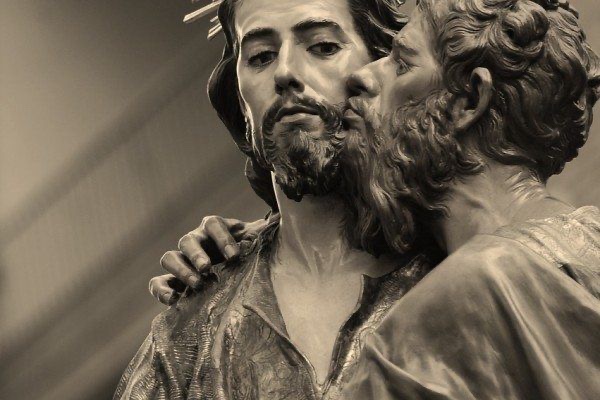
Our Lord didn’t want Judas to perish, just as he does not want anyone to perish. Even in his own arrest he tries to bring him to his senses, calling him “friend” and accepting the disciple’s kiss.

Commenting on this Gospel passage, Saint Josemaría said: “Look how great the virtue of hope is! Judas recognized Christ’s sanctity, and repented of the crime he had committed. So much so that he took the money that was the price for his treason and threw it down in front of those who had given it to him as his reward for his betrayal. But he lacked hope, which is the virtue needed to return to God. If he had had hope, he still could have been a great apostle. In any case, we don’t know what took place in the heart of that man, whether he responded to God’s grace in the last moment. Only God knows what happened in his heart. So never lose hope, never despair, even though you have done the most foolish thing possible. All you have to do is speak out, repent, and let yourself be led by the hand, and everything will be put right.”[4]

I would venture to say we have all had moments where we questioned our salvation. At times, perhaps you’ve wondered if your offenses were simply too great for God’s forgiveness. Hear these words. No matter how great our offenses, God’s mercy is always greater. “Fear and shame, which stop us from being sincere, are the greatest enemies of our perseverance. We are made of clay; but if we speak clearly, the clay acquires the strength of bronze.”[5]

The shadow of the cross grows darker as we draw closer. His sacrifice is the complete culmination of our faith. Yes, this week continues to get darker but the Hope of the world is about to prove once and for all that Light still shines!


[1] Francis, Homily, 5 April 2020.

[2] Saint Josemaría, Letters 2, no. 47a.

[3] Saint Augustine, Commentary on Psalm 108, no. 9.

[4] Saint Josemaría, Notes from his preaching, 8 December 1968.

[5] Saint Josemaría, Letters 2, no. 41a.

Share this:

  • Click to share on X (Opens in new window) X
  • Click to share on WhatsApp (Opens in new window) WhatsApp
  • More
  • Click to share on Facebook (Opens in new window) Facebook
  • Click to print (Opens in new window) Print
  • Click to email a link to a friend (Opens in new window) Email
  • Click to share on LinkedIn (Opens in new window) LinkedIn
  • Click to share on Reddit (Opens in new window) Reddit
  • Click to share on Pinterest (Opens in new window) Pinterest
  • Click to share on X (Opens in new window) X
Like Loading...

Lent Day 32: Jesus Had To Die

25 Thursday Mar 2021

Posted by Janean Tinsley in Lent

≈ Leave a comment

Tags

faith, God, Jesus Christ, Lent, sin

And they went to a place called Gethsemane. And he said to his disciples, “Sit here while I pray.” And he took with him Peter and James and John, and began to be greatly distressed and troubled. And he said to them, “My soul is very sorrowful, even to death. Remain here and watch.” And going a little farther, he fell on the ground and prayed that, if it were possible, the hour might pass from him. And he said, “Abba, Father, all things are possible for you. Remove this cup from me. Yet not what I will, but what you will.” And he came and found them sleeping, and he said to Peter, “Simon, are you asleep? Could you not watch one hour? Watch and pray that you may not enter into temptation. The spirit indeed is willing, but the flesh is weak.” And again he went away and prayed, saying the same words. And again he came and found them sleeping, for their eyes were very heavy, and they did not know what to answer him. And he came the third time and said to them, “Are you still sleeping and taking your rest? It is enough; the hour has come. The Son of Man is betrayed into the hands of sinners. Rise, let us be going; see, my betrayer is at hand.”
— Mark 14:32-42

As Lent draws near, the resurrection is on my mind. But you can’t have the resurrection without a death. So this question must be answered. Why did Jesus die?

We know from scripture that Jewish leaders plotted against him, Judas betrayed him, Herod and Pilate tried him, and the Roman soldiers executed him. But that’s not the real reason. As Acts 2:23 says, Jesus was “handed over by God’s deliberate plan and foreknowledge.”

Christ died for sins once for all, the righteous for the unrighteous, to bring you to God. (1 Pet. 3:18) The purpose of bringing us to God implies that, prior to Jesus dying, we were far away. “You who once were far away have been brought near through the blood of Christ” (Eph. 2:13).

Friends, our sin needed to be dealt with to bring us near: “Christ died for sins” (1 Pet. 3:18). The Bible does not mince words when it comes to human disobedience and its consequences. Hear that again. The Bible does not mince words when it comes to human disobedience and its consequences. Paul says in Romans 6:23 that “the wages of sin is death.” All humans stand condemned before God; our sins separate us from him whose character is pristine holiness and perfect justice. We are not in line with God when sin is left unaccounted.

To bring us near to God, “Christ died for sins, the righteous for the unrighteous” (1 Pet. 3:18). If “the unrighteous” is all of us, “the righteous” is Jesus himself. The one who “knew no sin, became sin” (2 Cor. 5:21)—our sin—so that we might receive mercy. There is simply no way to be a Christian without this understanding.

The New Testament tells us that Jesus died in our place. He paid the price for our redemption when he “gave his life as a ransom in the place of many” (Mark 10:45). Jesus reconciled us to God by bearing our sins himself (1 Pet. 2:24). “God presented Christ as a sacrifice of atonement through the shedding of his blood” (Rom. 3:25), exhausting God’s wrath against our unrighteousness. It is the only way we are redeemed.

Jesus’s death in our place is in accordance with the Old Testament Scriptures. His death fulfills the old covenant sacrifices, such as the sin offering, the Passover lamb, and the scapegoat of the Day of Atonement. He’s the Suffering Servant who was “pierced for our transgressions” (Isa. 53:5).

God’s love is all over that Holy Week. From the time Jesus entered the city to a chorus of hallelujahs to moment he took his final breath, God’s eternal love is profoundly evident. At the cross, we see the climax of God’s covenants with Israel, and we witness the final and dramatic proof of his love and justice.

Christ’s death puts beyond all doubt the fact that God loves us. It assures us that no matter what life throws at us, we can trust that “he who did not spare his own Son, but gave him up for us all . . . will also graciously give us all things” (Rom. 8:32).

At the cross we see not only God’s love, but the seriousness with which he takes our sin. “God presented Christ as a sacrifice of atonement . . . to demonstrate his justice” (Rom. 3:25–26).

God doesn’t forgive us by turning a blind eye to our sin or by overlooking it. Forgiveness is costly to the one against whom the wrong has been done.

Honestly, where would we be if God had not sent his Son to die for us? Without the cross, we’d be “darkened in our understanding of God and alienated from the life of God” (Eph. 4:18).

The death of Jesus is for life, not just for Easter. The death of Jesus changes everything. As you prepare to take the final few steps of Lent, join Paul in saying, “I will never boast about anything except the cross of our Lord Jesus Christ” (Gal. 6:14). Praise God!!

Share this:

  • Click to share on X (Opens in new window) X
  • Click to share on WhatsApp (Opens in new window) WhatsApp
  • More
  • Click to share on Facebook (Opens in new window) Facebook
  • Click to print (Opens in new window) Print
  • Click to email a link to a friend (Opens in new window) Email
  • Click to share on LinkedIn (Opens in new window) LinkedIn
  • Click to share on Reddit (Opens in new window) Reddit
  • Click to share on Pinterest (Opens in new window) Pinterest
  • Click to share on X (Opens in new window) X
Like Loading...

Lent Day 29: It’s fine. Everything’s fine.

22 Monday Mar 2021

Posted by Janean Tinsley in Lent, mental health

≈ Leave a comment

Tags

faith, God, Jesus Christ, Lent, pain, sin

I cry aloud to God, aloud to God, that he may hear me. In the day of my trouble I seek the Lord; in the night my hand is stretched out without wearying; my soul refuses to be comforted. I think of God, and I moan; I meditate, and my spirit faints. You keep my eyelids from closing; I am so troubled that I cannot speak. —Psalm 77

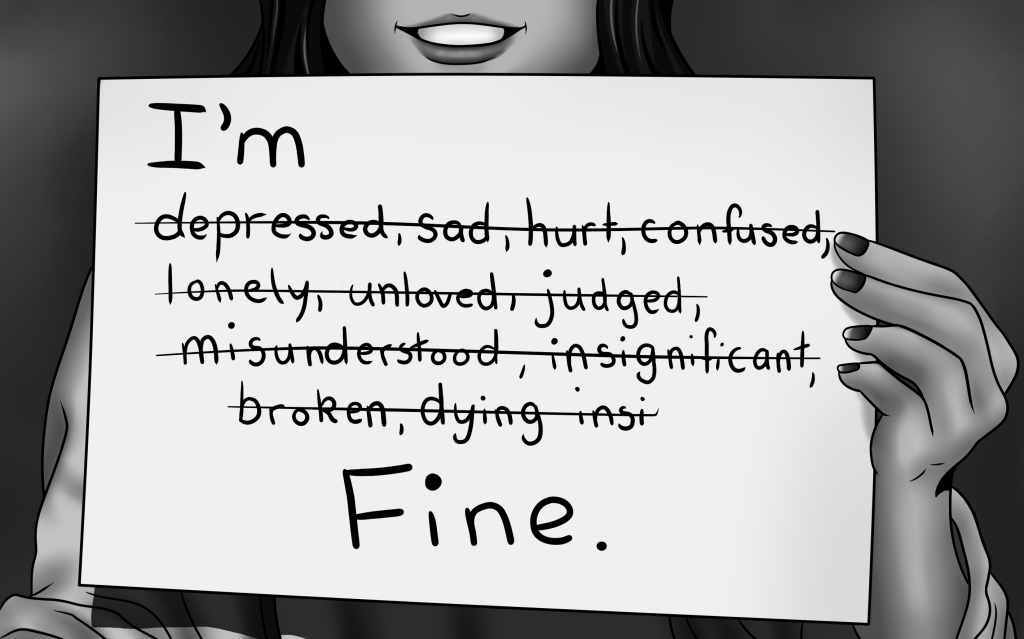
“I’m fine. It’s fine. Everything is fine.” So many of my clients have recited these words for so long they have forgotten how to acknowledge their real pain. I have found that people will quietly endure pain described in this psalm for weeks, months, or even years on end, until they finally become overwhelmed. This often takes the form of a divorce, an arrest, or a suicide attempt.

What do we do during the “day of trouble?” We cry aloud to God to find comfort, but for some reason, “my soul refuses to be comforted.” We lose sleep, and we cannot even describe the anguish we are in. On top of all of this, we experience a theological crisis: “God promised to never leave or forsake me, but now he has turned his back on me.”

Occasionally, clients will reveal that they have reached out to God during dark times, but they felt all they received was silence. They asked for relief from the pain but they feel forgotten. They are praying like they’ve never prayed before, but still their pain overwhelms. “Has God forgotten to be gracious?” (v. 9).

Perhaps that is the whole point. Scripture reminds us over and over that God is merciful and abounding in steadfast love (Exodus 34:6–7), that God never changes (Hebrews 13:8), and that God desires an intimate relationship with his people (Isaiah 43:1; Jeremiah 31:33). Scripture assures us that God is our everlasting hope. Because of these promises, I do not believe that God causes our suffering. I do believe He can certainly use our suffering so that we might “cry aloud to God,” “think of God,” and “meditate and search my spirit.” The psalmist reminds us that even amid our suffering, it is out of God’s character to spurn or abandon, to be unloving or to withhold compassion. Even on our darkest days, God is inseparable from his goodness and mercy. For that, as we draw ever closer to the cross, we can persevere.

Share this:

  • Click to share on X (Opens in new window) X
  • Click to share on WhatsApp (Opens in new window) WhatsApp
  • More
  • Click to share on Facebook (Opens in new window) Facebook
  • Click to print (Opens in new window) Print
  • Click to email a link to a friend (Opens in new window) Email
  • Click to share on LinkedIn (Opens in new window) LinkedIn
  • Click to share on Reddit (Opens in new window) Reddit
  • Click to share on Pinterest (Opens in new window) Pinterest
  • Click to share on X (Opens in new window) X
Like Loading...

Lent Day 27: Cover Me

19 Friday Mar 2021

Posted by Janean Tinsley in Lent

≈ 1 Comment

Tags

faith, God, Jesus Christ, Lent, sin

And He said to Adam, “Because you listened to your wife’s voice and ate from the tree about which I commanded you, ‘Do not eat from it’: The ground is cursed because of you. You will eat from it by means of painful labor all the days of your life. It will produce thorns and thistles for you, and you will eat the plants of the field. You will eat bread by the sweat of your brow until you return to the ground, since you were taken from it. For you are dust, and you will return to dust.” Adam named his wife Eve because she was the mother of all the living. The Lord God made clothing out of skins for Adam and his wife, and He clothed them. The Lord God said, “Since man has become like one of Us, knowing good and evil, he must not reach out, take from the tree of life, eat, and live forever.” So the Lord God sent him away from the garden of Eden to work the ground from which he was taken. He drove man out and stationed the cherubim and the flaming, whirling sword east of the garden of Eden to guard the way to the tree of life. — Genesis 3:17-24

When the world was created, God designed paradise for Adam and Eve. But unfortunately our beautiful paradise was destroyed by the introduction of sin. God pronounced judgment on sin, thus leaving us to feel consequences such as shame. In Genesis 3:21: “And the LORD God made for Adam and for his wife garments of skins and clothed them.”

God looked at their clothes and said, “Nope. That’s not going to work.” The clothes that Adam and Eve had made for themselves were not adequate covering to face the new fallen world in which they were now living. Sin had opened their eyes, but not in a good way. Sin laid them bare, left them feeling exposed. For the first time, they realized they were naked. So, they sewed fig leaves together and made themselves loincloths, single-piece garments. And ever since, the human race has engaged in an enterprise of self-covering that always falls short.

How often do we try to cover ourselves so that others cannot see our sinfulness? Covering sin is not simple, quick, and easy. Covering sin is costly, painful … bloody. Sin produces suffering and death, so the cost of covering sin involves suffering and death. It involves sacrifice.

Did Adam and Eve think they could just sweep things under the rug, tidy up the disastrous mess they had made without any cost, without any price being paid? Do we think that? When we try to cover our own sin, we are engaging in a futile self-salvation project. We are essentially saying, “I can atone for my own sin.”
God makes it very clear that sin requires the ultimate sacrifice. And then because of His profound love, he sent that sacrifice. Jesus Christ suffered and bled and died so that we could be adequately clothed—clothed in his righteousness. The blood of Jesus is our covering. Just like Adam and Eve, we can’t cover our own sin. God must do that, and he has made that possible with the costly sacrifice of his own Son. In light of this: “I will greatly rejoice in the LORD; my soul shall exult in my God, for he has clothed me with the garments of salvation; he has covered me with the robe of righteousness” (Is. 61:10).

Are you ready to have your sins covered by Jesus Christ? If so, let’s talk.

Share this:

  • Click to share on X (Opens in new window) X
  • Click to share on WhatsApp (Opens in new window) WhatsApp
  • More
  • Click to share on Facebook (Opens in new window) Facebook
  • Click to print (Opens in new window) Print
  • Click to email a link to a friend (Opens in new window) Email
  • Click to share on LinkedIn (Opens in new window) LinkedIn
  • Click to share on Reddit (Opens in new window) Reddit
  • Click to share on Pinterest (Opens in new window) Pinterest
  • Click to share on X (Opens in new window) X
Like Loading...

Lent Day 23: Today’s Hope

16 Tuesday Mar 2021

Posted by Janean Tinsley in Lent

≈ Leave a comment

Tags

Jesus Christ, Lent, sin

And Jonah began to enter into the city a day’s journey, and he cried, and said, Yet forty days, and Nineveh shall be overthrown. — Jonah 3:4

We know that the Bible is a book of hope. But let’s be honest, there are stories throughout the book that make us wince. Sometimes they leave us asking God what He was doing.

When the prophet Jonah entered Nineveh, he gave a message of hopelessness — in 40 days your city will be destroyed! What?? That can’t be right. Unfortunately he did not say, Nineveh will be destroyed “unless“, but emphatically prophesied destruction to the people of the city — seeming to say their situation was hopeless.

Hearing a prophecy like that could cause anyone to throw up their hands in surrender. Yet hearing this message Nineveh repented, and because their repentance was genuine God spared the city for a season. Many lives were saved.

Jonah’s prophecy of judgment was averted and Nineveh’s destiny was changed by their response to the deep conviction from a message of doom. In other words, Nineveh recognized just how sinful they had become and found conviction to repent. That’s how it is with God. He is so compassionate, so longing to forgive and restore people to Himself, that He gladly offers mercy to those who genuinely seek it.

Is there a “prophecy of doom” over your life? Do you feel like our world is dangerously close to the sinful Nineveh? Are our sins piled so high that God’s judgment seems irrevocable and imminent? Don’t despair … repent! With our compassionate God, there is hope even when it seems all is lost. If Nineveh, a pagan city, hardened and ripe for judgment and “hopelessly” heading toward destruction, could be saved, shouldn’t you also have hope? Turning to the Lord is not difficult. But only you can make that decision. Make this Easter a resurrection of your life in Christ Jesus.

Share this:

  • Click to share on X (Opens in new window) X
  • Click to share on WhatsApp (Opens in new window) WhatsApp
  • More
  • Click to share on Facebook (Opens in new window) Facebook
  • Click to print (Opens in new window) Print
  • Click to email a link to a friend (Opens in new window) Email
  • Click to share on LinkedIn (Opens in new window) LinkedIn
  • Click to share on Reddit (Opens in new window) Reddit
  • Click to share on Pinterest (Opens in new window) Pinterest
  • Click to share on X (Opens in new window) X
Like Loading...

Lent Day 21: What’s The Cost?

13 Saturday Mar 2021

Posted by Janean Tinsley in Lent

≈ Leave a comment

Tags

faith, God, Jesus Christ, Lent, sin

“In your relationships with one another, have the same mindset as Christ Jesus:

Who, being in very nature God, did not consider equality with God something to be used to his own advantage; rather, he made himself nothing by taking the very nature of a servant, being made in human likeness. And being found in appearance as a man, he humbled himself by becoming obedient to death—even death on a cross! Therefore God exalted him to the highest place and gave him the name that is above every name, that at the name of Jesus every knee should bow, in heaven and on earth and under the earth,
and every tongue acknowledge that Jesus Christ is Lord, to the glory of God the Father.”
— Philippians 2:5-11

Philippians 2 says this of Jesus Christ: “He made himself nothing, taking the form of a servant, being born in the likeness of men. And being found in human form, he humbled himself by becoming obedient to the point of death”. While his death was a clear sacrifice, the fact is that Jesus’ entire life was marked by sacrifice—giving up his rights as a King for the sake of others.

From the moment he was born, his feet were always walking toward the ultimate sacrifice of that brutal Roman cross. Have you ever wondered why sacrifice is so central to God’s plan of redemption and reconciliation? Why couldn’t God just forgive people of their sins without sacrifice?

If you think about what it means to bring about reconciliation in a human relationship, you can see how sacrifice is always part of the process.it forces a personal cost. If you get angry at someone over some issue, to reconcile means work. It will cost you something to forgive because you have to absorb the pain of the offense. You will have to sacrifice your right to be angry and move toward forgiveness. Actually, both parties have to pay a price. The bottom line is that without sacrifice there is no reconciliation. There is only hardness of heart and death of relationship.


In a very similar way, we must sacrifice in order to move toward God with confession and repentance. We must come to the end of ourselves, killing any sense of pride and self-righteousness. But we are not the ones who move first. It is not our sacrifice that saves us. God’s plan of redemption is primarily about his sacrifice, not ours.
I read once that redemption is a term of value, so there must be a cost involved. To redeem means to buy back, to regain possession of something in exchange for payment. Because we are created in the image of God and he loves us, he considered us worth the cost of redemption. However, the full cost of redeeming a human being is staggering. What does it cost to buy a person back from the realm of sin and death, from the reign of Satan? The cost is commensurate with the destruction that sin, death, and Satan have brought to humanity. The cost is beyond our ability to pay. No amount of sacrifice on our part would enable us to cover the cost. Thankfully, the full cost fell on Jesus. All of the curses of the Fall, most notably our sin and the resulting death, were placed on Christ. His sacrifice makes our reconciliation with God possible. Thanks be to God!

If you are still hanging on to the sins in your life, my friend, it’s time to allow God into your life. Nothing in this world is worth the eternal salvation Jesus Christ offers us!

Share this:

  • Click to share on X (Opens in new window) X
  • Click to share on WhatsApp (Opens in new window) WhatsApp
  • More
  • Click to share on Facebook (Opens in new window) Facebook
  • Click to print (Opens in new window) Print
  • Click to email a link to a friend (Opens in new window) Email
  • Click to share on LinkedIn (Opens in new window) LinkedIn
  • Click to share on Reddit (Opens in new window) Reddit
  • Click to share on Pinterest (Opens in new window) Pinterest
  • Click to share on X (Opens in new window) X
Like Loading...

Lent Day 20: Repentance and Grace

12 Friday Mar 2021

Posted by Janean Tinsley in Lent

≈ 4 Comments

Tags

faith, God, Jesus Christ, Lent, sin

And as he was setting out on his journey, a man ran up and knelt before him and asked him, “Good Teacher, what must I do to inherit eternal life?” And Jesus said to him, “Why do you call me good? No one is good except God alone. You know the commandments: ‘Do not murder, Do not commit adultery, Do not steal, Do not bear false witness, Do not defraud, Honor your father and mother.’” And he said to him, “Teacher, all these I have kept from my youth.” And Jesus, looking at him, loved him, and said to him, “You lack one thing: go, sell all that you have and give to the poor, and you will have treasure in heaven; and come, follow me.” Disheartened by the saying, he went away sorrowful, for he had great possessions. And Jesus looked around and said to his disciples, “How difficult it will be for those who have wealth to enter the kingdom of God!” And the disciples were amazed at his words. But Jesus said to them again, “Children, how difficult it is to enter the kingdom of God! It is easier for a camel to go through the eye of a needle than for a rich person to enter the kingdom of God.” And they were exceedingly astonished, and said to him, “Then who can be saved?” Jesus looked at them and said, “With man it is impossible, but not with God. For all things are possible with God.” Peter began to say to him, “See, we have left everything and followed you.” Jesus said, “Truly, I say to you, there is no one who has left house or brothers or sisters or mother or father or children or lands, for my sake and for the gospel, who will not receive a hundredfold now in this time, houses and brothers and sisters and mothers and children and lands, with persecutions, and in the age to come eternal
life. But many who are first will be last, and the last first.”
— Mark 10:17-31

We are now over halfway through Lent. Throughout the journey so far, a lot has been said about sin and repentance. It’s not a fun, lightweight topic. No one likes to think about sin unless it’s someone else’s. But we’ve been called to repent as a way to take ownership of our sinfulness. It’s not a suggestion. Rather, it’s a directive from God.

Martin Luther said the Christian life is a walk of repentance and faith. But why? Why is it so important?

Repentance is a response to God’s grace. It leads to joy and restoration. Not frustration from trying harder, and not despair from beating yourself up. Those are forms of penance. Jesus is the end of the law for righteousness to everyone who believes (Romans 10:4). He condemned sin in the flesh in order that the righteous requirements of the law might be fulfilled in us, who walk not according to the flesh but according to the Spirit. There is therefore now no condemnation for those who are in Christ Jesus (Romans 8:1-4). Repentance is motivated by love for God and a desire for fellowship with him.

King David said, “Have mercy on me, O God, according to your steadfast love; according to your abundant mercy blot out my transgressions. Wash me thoroughly from my iniquity, and cleanse me from my sin! For I know my transgressions, and my sin is ever before me” (Psalm 51:1-3). David was not a man without sin. He, like each of us, succumbed to the world. Only when he came clean with God did he experience the grace of God: “I acknowledged my sin to you, and I did not cover my iniquity; I said, ‘I will confess my transgressions to the LORD,’ and you forgave the iniquity of my sin.” (32:5).

Repentance is taking responsibility for our sin. The problem is not just the sin, but that each of us is sinful. It would not be enough to clean the outside of the cup, which is why we must seek a deeper cleansing: “Behold, you delight in truth in the inward being … Purge me with hyssop, and I shall be clean; wash me, and I shall be whiter than snow … Create in me a clean heart, O God, and renew a right spirit within me.” (Psalm51:6-7, 10).

Repentance is turning to God in faith. In everyday language, repentance means to “change your mind,” to reconsider how you are living your life in light of your new identity in Christ. Left to our own accord, we are prone to pursue life on our terms, and to locate our sense of worth and joy in places apart from God. So the call to repentance is a standing invitation to give up our idolatrous pursuits, and turn to the one true God who restores us to the life for which we were made. We cannot save ourselves.
Repentance is initial and ongoing. That’s why you must be in humility and seek God’s grace.

If you are in a place where the old you is ready to be cleansed, it’s time to repent of your sins, and say yes to God.

Share this:

  • Click to share on X (Opens in new window) X
  • Click to share on WhatsApp (Opens in new window) WhatsApp
  • More
  • Click to share on Facebook (Opens in new window) Facebook
  • Click to print (Opens in new window) Print
  • Click to email a link to a friend (Opens in new window) Email
  • Click to share on LinkedIn (Opens in new window) LinkedIn
  • Click to share on Reddit (Opens in new window) Reddit
  • Click to share on Pinterest (Opens in new window) Pinterest
  • Click to share on X (Opens in new window) X
Like Loading...
← Older posts

Topics

Facebook

Facebook

Recent Posts

  • A Turning Point
  • What Is Church Hurt? Breaking the Silence on Spiritual Wounds
  • Your Tears Matter
  • What’s Wrong With The World?
  • Betrayal Trauma and the Church

Archives

  • September 2025
  • August 2025
  • July 2024
  • August 2022
  • June 2022
  • May 2022
  • April 2022
  • February 2022
  • January 2022
  • September 2021
  • August 2021
  • July 2021
  • June 2021
  • May 2021
  • April 2021
  • March 2021
  • February 2021
  • January 2021
  • December 2020
  • November 2020
  • October 2020
  • September 2020
  • July 2020
  • June 2020
  • May 2020
  • April 2020
  • March 2020
  • January 2020
  • December 2019
  • August 2019
  • February 2019
  • May 2018
  • April 2016
  • December 2015
  • September 2015
  • May 2015
  • January 2015
  • September 2014
  • January 2014
  • December 2013
  • November 2013
  • August 2013
  • July 2013
  • September 2012
  • August 2012
  • May 2012
  • March 2012
  • January 2012
  • November 2011
  • October 2011
  • September 2011
  • RSS - Posts
  • RSS - Comments

Faithful Servant Ministries

Faithful Servant Ministries

Blog Stats

  • 13,801 hits

Blog at WordPress.com.

  • Subscribe Subscribed
    • Lord, have mercy…
    • Join 91 other subscribers
    • Already have a WordPress.com account? Log in now.
    • Lord, have mercy…
    • Subscribe Subscribed
    • Sign up
    • Log in
    • Report this content
    • View site in Reader
    • Manage subscriptions
    • Collapse this bar
 

Loading Comments...
 

    %d